
How to choose industrial wheels: a step-by-step guide
Load per wheel, floor type, tread material, diameter, bracket and environment: the six facts that decide which wheel your trolley or equipment needs.
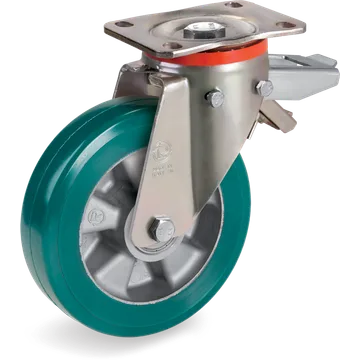
Choosing the right industrial wheel saves money twice: it lasts longer and the equipment takes less effort to move. A poor choice usually shows up quickly as deformed treads, marked floors or trolleys that are hard to get moving. These are the six facts worth having clear before you order, in the order we check them ourselves.
1. Load per wheel
This is the starting point. Add the weight of the equipment (the trolley, the platform, the machine) to the maximum load it will carry, and divide by the number of wheels that are actually in contact with the floor. With four or more wheels, it is wise to count one fewer: on a floor that is not perfectly flat, there is always one that is almost in the air.
For example, an 80 kg trolley carrying 520 kg on four wheels: 600 kg ÷ 3 = 200 kg per wheel. If the floor has joints, ramps or small obstacles, add a 30 % margin (260 kg); if there are impacts or it works outdoors, 60 %. Our load calculator does the maths for you.
Catalogue capacities are given in daN (1 daN ≈ 1 kg) and, unless stated otherwise, at walking speed (4 km/h). For towed or powered equipment, which moves faster, the capacity drops: ask us.
2. The floor
The floor decides the tread material as much as the load does:
- Smooth and in good condition (polished concrete, resin): suits hard treads, which roll with very little effort.
- With joints, potholes or debris: elastic treads are better, as they absorb impacts instead of passing them on to the load.
- Delicate (parquet, vinyl, tiles): soft, non-marking treads that leave no marks.
3. The tread material
- Rubber: quiet, with good grip and the kindest to the floor. For light and medium loads. For example, series 22 (non-marking) and 52.
- Polyurethane: the balance between capacity, smooth rolling and floor care, and the most versatile option for industry. Series 64, TR polyurethane on a cast iron centre, covers everything from workshop trolleys to heavy platforms; series 62 (TR-Roll) stands out for its easy start-up.
- Polyamide or cast iron: rigid wheels with minimal rolling resistance that withstand oils and chemicals. In return they are noisier and unforgiving on uneven floors. Series 68 and 69.
- High performance (TR-PowerHigh and Vulkollan®): for high loads, long shifts and powered vehicles. Series 58 and 63.
If you are torn between two materials, polyurethane is rarely a bad choice.
4. The diameter
The larger the wheel, the easier it is to push and the better it rolls over joints, cables and ramps; with the same material, it also carries more. The trade-off is height: check the overall height (from the floor to the top plate) your equipment allows. For manual trolleys, 125 or 160 mm is a common size; below 100 mm, the effort rises sharply as soon as the floor is not perfect.
5. The bracket and fixing
- Swivel or fixed: two swivel and two fixed castors give a trolley that runs straight and is easy to steer down long aisles; four swivel castors let you manoeuvre in tight spaces, although it is harder to keep the trolley in a straight line.
- Brake: at least on the swivel castors if the equipment must stay still on a slope, or while it is loaded and unloaded.
- Fixing: with a top plate (the most common), a stem or a bolt hole. If you are replacing a wheel, measure the plate and the distance between the holes (we explain how in how to measure a wheel).
- Bearing: roller bearings are robust and economical for high loads; ball bearings turn more smoothly and cope better with continuous use; a plain bore is for occasional use.
For very high loads, the welded brackets in the heavy-duty range reach up to 6,000 daN.
6. The environment
- Humidity, washdowns or food: brackets and bearings in stainless steel. See also wheels for the food industry.
- Ovens, dryers or bakeries: high-temperature wheels.
- Electronics or explosive atmospheres: antistatic and conductive wheels.
- Outdoors and rough ground: pneumatic wheels or puncture-proof ones.
With these facts, you are ready to search
In the wheel finder you can filter by diameter, minimum load, tread material, bracket type, fixing and brake. If you would rather choose together with us, tell us the load, the floor and the use through the contact form or on WhatsApp, and we will suggest the right Tellure Rôta reference with price and lead time.